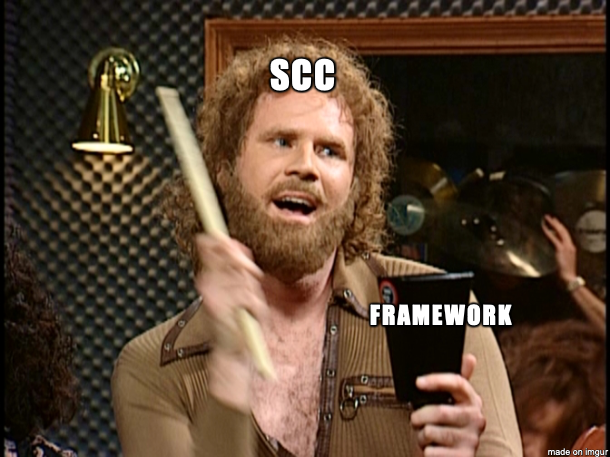
In Societé des Casinos du Québec inc. v. Association des cadres de la Société des casinos du Québec, 2024 SCC 13, the Supreme Court of Canada reached yet another level of framework usage, setting season-high numbers (and possibly an all-time peak) for both total “frameworks” and usage rate.
- Reference re An Act: 17 “frameworks” in 137 paragraphs (12.4 FWs/100 para)
- Dickson: 59 “frameworks” in 523 paragraphs (11.3 FWs/100 para)
- Societé des Casinos: 103 “frameworks” in 221 paragraphs (46.6 FWs/100 para)
Truly impressive – and potentially historic – numbers, but our insights remain limited by the small sample size: advanced framework stats go back only to R. v. Vu, 2024 SCC 1.
Unlike in Dickson, where the Court deployed both legal and analytical frameworks, the judgments in Societé des Casinos concentrated on the latter category and almost exclusively on the Dunmore framework for analyzing claims under s. 2(d) of the Charter. When used as a metaphor to emphasize the rigour and clarity of the Court’s own tests, approaches, and analyses, the notion of a “framework” raises fewer obvious questions about Canada’s constitutional structure and the relationships between interlocking statutory, treaty, constitutional, and international law instruments.
Nonetheless, the Court’s framework fixation does suggest strong beliefs among the justices about their role on our “apex” court (e.g. providing clear guidance for lower courts and other branches of government to exercise their respective powers), which in turn implicate ideas of institutional competence, the separation of powers, and…constitutional structure. Some justices have already made their positions on these issues clear, in reasons such as the dissent in R. v. Kirkpatrick, 2022 SCC 33 (joined by Coté J, Rowe J, and Wagner CJ: 46 “frameworks” in just 201 paragraphs, for a very respectable rate of 22.8 FWs/100 para). Other justices tend to demonstrate rather than elaborate those ideas.
The concern remains that all this talk of frameworks risks distracting us from important developments taking place beneath the orderly – and repetitive – rhetorical surface.
For example, the entire Court in Societé des Casinos agreed that the standard of correctness applies when courts review findings of mixed law and fact made in connection with a constitutional question (¶¶45 and 94-97, citing Vavilov ¶¶93, 95). A “mixed” finding is one that determines “whether the facts satisfy the applicable legal tests” (¶94, citing Westcoast Energy Inc. v. Canada (National Energy Board), [1998] 1 S.C.R. 322, at ¶38). Specifically, the Court in Societé des Casinos reviewed whether the exclusion of certain managers from a statutory labour relations regime constituted “substantial interference” with the right to meaningful collective bargaining.
But the majority in Vavilov did not identify mixed findings of law and fact as one of the exceptions to default reasonableness review. The only questions that are reviewed on correctness are “certain types of legal questions: constitutional questions, general questions of law of central importance to the legal system as a whole and questions regarding the jurisdictional boundaries between two or more administrative bodies.” (Vavilov, ¶53). Professor Paul Daly, in his definitive book on Vavilov, has noted that questions of mixed fact and law are reviewed on the default standard of reasonableness (A Culture of Justification: Vavilov and the Future of Administrative Law (2023), p 135).
The Court in Societé des Casinos appears to have recognized another category subject to correctness review: mixed findings of law and fact connected with a constitutional question. This is not an empty set. Nor is it sparsely populated. Introduced with little fanfare or obvious consideration, it could ensnare findings from a wide range of regulatory domains.
For example, the duty to consult is a constitutional duty. It arises from the honour of the Crown, which is an unwritten constitutional principle (Little Salmon, ¶42; Manitoba Metis Federation, 2013 SCC 14, ¶69)…and maybe also a constitutional imperative (Mikisew Cree First Nation v. Canada, 2018 SCC 40, ¶55 (Abella J., concurring)). In Haida Nation and Carrier Sekani Tribal Council, the Court found that the question of whether Crown conduct satisfied the constitutional standard of “meaningful consultation” is a question of mixed fact and law subject to the standard of reasonableness (Haida ¶¶61-63; CSTC ¶¶65, 78).
The Court’s standard of review jurisprudence now appears to give more deference to decisions that impact aboriginal rights than to decisions that impact Charter rights:
- whether government conduct constitutes substantial interference with the right to meaningful collective bargaining protected by s. 2(d) of the Charter is a mixed question of law and fact subject to correctness review;
- whether government conduct constitutes meaningful consultation with respect to potential impacts on aboriginal rights or title protected by s. 35 of the Constitution Act, 1982 is a mixed question of law and fact subject to reasonableness review.
Vavilov did not distinguish between aboriginal rights and other constitutionally protected rights. Does the constitutional imperative of reconciliation (Shot Both Sides v. Canada, 2024 SCC 12, ¶79) warrant or require greater deference than in other constitutional contexts? If so, does it entail more deference to the Crown or to the indigenous peoples affected by contemplated Crown conduct (and the ongoing imposition of Crown sovereignty and the myriad harms of colonialism)? What role do indigenous peoples and indigenous legal orders have in realizing the Canadian constitutional principle of the rule of law?
These are big, important questions. We may not have answers to them yet, but we can always have “more framework.”
Leave a Reply